Friday, November 22, 2013

SUNOMONO & NASUNO HUKUMENI


Sunomono is just a pickled salad, in this case we added sashimi quality octopus which brings the ABC salad to the next level.

Nasuno Hukumeni is boiled eggplant but with a difference, an elegant taste that matches the chicken and beef nicely.

------------------------------------------

* 1 cucumber, 10gm of Wakame seaweed
* 2 table spoons of rice vinegar
* 1 table spoon of sugar
* 1/2 tea spoon of soya sauce

Thin slice the cucumber, add a pinch of salt to take out the water the squeeze the dry. Mix all the ingredients with the cucumber, lastly, add the octopus pieces.

------------------------------------------

* 6 baby eggplants (Nasuno) halved
* 2 cup of Dashi
* 2 table spoons of sake
* 2 table spoons of sugar
* 3 table spoons of soya sauce
* 1 small piece of ginger, grated

Make thin cuts on the skin of the eggplants, leave in water for a few minutes. Heat up the ingredients, place eggplants skin side down once boiling, with lid on. Boil with low heat x 5 minutes, turn eggplant over, for 5 more minutes, remove from heat, let them cool off before serving with grated ginger as garnish.

Try them right away, you will feel good as they will taste genuine, and good. The only problems is it will be next to impossible to get quality baby eggplants at home. The long, purple ones from China are singularly flavorless.

NIKU DAY

Day 5 - after 4 days of Sakana or seafood Sensei thought meat should be next, and so we did.  I call it the 'Nameshida Don Parade' as we prepared 2 signature rice bowls, accompanied by chickens 2-way and 2 delicious sides.

Oyako Don  is chicken & egg on rice, playing on the word Oyako meaning parent and child.  While it captures the spirit of the dish well but to a Buddhist it is hell turned over as we 'cooked them both' to please our palate. The key trick for this recipe is not to whisk the eggs too hard, and not to over-cook so the yolk and white will present themselves like a irregular landscape over the rice. The rest is easy, primarily chicken and onion cooked in Dashi soup stock, and seasoned.

Gyu Don is beef rice of the Yoshinoya variety is just as simple. Come to think of it the seasoning sauce for meats is quite standard ie Soya Sauce, Sugar, Sake & Mirin or Sweet Sake ... QED!  Grated ginger is used to cook with the meat to rid the raw meaty taste.

Next to the Dons we prepared Kara-Age aka fried chicken. The word is formed by 2 Chinese characters or Kangi which means 'Chinese' and 'raise' something like that, meaning deep fry. No mention of chicken anywhere so the verb is also a noun.  Strange? In a generic sense 'Age-mono' means deep fried items, and 'Tsuke-mono' means pickled items. The other accompaniment is just a run-of-the-mill Teriyaki Chicken.

I was more intrigued by the 2 side dishes which is a separate blog, with the recipes.

ROPPONGI

Roppongi is ageless, we walked around with glee as a couple for the first time back in 1982 and fast forward 31 years we still find joy at our pilgrimages to Roppongi. It is an action place, so to speak, but we are no longer any part of today's action. If I want to be honest we were no more than eager bystanders even in yesterday's action, never mainstream.  

A few happenings to illustrate the changing times; the beautiful baby and toddler shop with cute handmade animal motif pillows (which I think our girls kept) is now a Donna Kebab fast food joint, imagine that? The shop with a huge marijuana leaf logo at the front, which drew huge crowds with their range of pipes and accessories, is now a foot massage parlour run by Beijing compatriots; an elegant alfresco coffee shop where beautiful people hanged out has been redeveloped to another vulgar mini mall for cosmetics ... Fancl, La Mer, SKII ... can someone please explain why non-white people want white skin?  

One thing I noticed, the crowd has receded, it is no longer shoulder to shoulder.  It was a Thursday evening I know but the traffic was mostly office workers quick stepping to the Hibiya Line for home, not that many tourists and the shops and eateries were nowhere near full. I detected a sense of melancholy but then again, it could just be me. It is nothing a bowl of decent Ramen cannot reverse though.

Thursday, November 21, 2013

MORE RAMEN

The year was 2001 when Terri relocated from Boston to join the investment banking arm of JPMorgan here in Tokyo, as a Junior Associate. Dora and I visited her, and was introduced to this Ramen outlet in Roppongi. It immediately hit the top of my chart. I have many charts when it comes to food and eating, needless to say this is the universal Ramen list. Their style is more attuned to northern Chinese origins, notably lots of chopped garlic in a heavy handed soup base. One uniqueness is raw garlic cloves on the table, like Korean BBQs. Since 12 years ago we have been back whenever we are in town. That said I must admit my taste has moved from far right to the center line what with high cholesterol, BMI, blood pressure and so on. Tonight my vote was 6-7 on a scale of 10 verses a definitive 9 last night.  If this were any guide, my political leaning, with the current Hong Kong Government (what and how do they govern anyway) has moved even farther a field to the left. Back to Ramen ... I found this soup base way too heavy, compared to the one near Shimbashi Station, which was altogether lighter and I can taste the noodle better. The flyer on the right was a special promotion. From the Chinese characters it is the relaunch of a 3-Miso soup base 'that has gained popularity' or something like that. While the place has survived since the late 1990s (the chain itself was opened in 1985) their energy and following seem to have faded. With only a handful of customers at dinner time, the flair was lost, or at least not as dominant as we were used to. While the change in taste is all about me, maintaining the style of the place should be about them. Don't you agree?      

FUN NEW YEAR EATS

To the left ... Kobu-Maki which was fish (in this case Migaki-Nishin) rolled in Konbu and slow cooked. The ribbon was Kampyo, for decoration more than anything else. It did not taste as good as it looked as the kelp was hard, the Kampyo without taste, and the fish was blend from being braised for too long.  Then again, this recipe is supposed to bring Happiness (play on word Yorokobu for happiness) so why not? Have another one!

To the right ... Kazari-Kamaboko which was made from a block of processed fish paste.  Though commercial tasting, it was rather good, reminded me of high quality 'fish balls' in Bangkok & Singapore.

As Sensei said, these are served once a year. I should therefore shut up and focus on how they can uphold tradition, rather than making irrelevant remarks. Apologies!        

OSECHI OJU

Day 4 - Osechi is new year, a key festival in the Japanese calendar and Oju literally means 'to present' or in this case the elegant box in which special new year treats are presented. In short, a Super Bento!

Sensei shared with us a Japanese 'tradition', a classic good news-bad news scenario. The Good News ... all housewives will get the first 3-days of the New Year off, with no kitchen work. The Bad News ... before that happens they will break their backs for 3, if not 6, even 9 days before New Year's Eve so the family can be fed - in fact well fed, by treats they only get once a year at this time - during the 3 days when housewives are supposed to be 'off'.  I was not sure if that was a joke at first. It is obviously not, speaking of getting the short end of a stick!

Back to the kitchen, what you see in the picture took Sensei and 3 of us 4-hours to prepare. Like the Chinese these treats are all well meaning, carrying messages of health, wealth, prosperity and so on ... tradition casts a long and overwhelming shadow, much more so than in Hong Kong, even China I should add. Let me share with you some examples :

*  Kobu-Maki or kelp roll plays on the word Yorokobu, meaning happiness
*  Satoimo or taro is a plant that grows fast, meaning more babies
*  Renkon or lotus root, the holes mean one can look into the future
*  Kuri or chestnuts carries a golden shine, meaning wealth
*  Kazari Kamaboko or decorated fishcake resembles sunshine
*  1st sunrise in the New Year is sacred to all Japanese
*  Date-Maki or sweet omelette carries well wishes in knowledge & education      
*  Namasu or carrot & Daikon salad, red & white are celebration colors, meaning peace
*  Soba is served at mid night on New Year's Eve, meaning longevity

So warm, so sentimental, so romantic, so genuine, so traditional, and above all so tasty.  Needless to say today was much more than cooking, it was a lesson in Japanese culture. We cannot help feeling sorry for the housewives and mothers who have to sweat so tradition can triumph.  I propose a toast to all the behind the scene kitchen goddesses, may their strength and stamina win all. Come to think of it we are only 5-weeks away from the next Operation Osechi Oju, unbelievable.

With early well wishes for a Happy New Year!

OSUIMONO

I love this 'clear soup' as it is so simple and yet carries so much flavor. It is an additive to almost anything served, whether it is meat or fish or seafood or vegetables. It can be a pleasing cleanser between courses too so it is an all-purpose recipe.

The main concern in Osuimono is, again, Dashi so if you are serious about learning to book Japanese you must start with a serious Dashi .. the 'Mother Soup or Stock Base'.

Bring the Dashi to a boil, then season with a splash of soya sauce, a sprinkle of salt and a dash of sake. Place small silky tofu cubes and Mitsuba - rub the stalks to soften and tie a butterfly knot in the middle for presentation - in a soup bowl, and pour in Dashi carefully.  Other options to add are; mushrooms, clams, baby shrimps, seaweed, bamboo sprouts, radish sprouts etc  Lastly, garnish with Yuzu zest if avaialble.

CHARWAN-MUSHI

This is a favorite in most Japanese restaurants in Hong Kong, apparently it is an all time favorite in Japanese families as well as in Kaiseki menus, per Sensei.  It is another simple 'practice-makes-perfect' recipe.

* 300cc of Dashi
* 2 eggs with a pinch of salt
* Morsels of chicken & Baby Shrimps
* Shiitake or other kinds of mushrooms

Whisk the eggs, add Dashi, a sprinkle of soya sauce and strain the mixture. Put the chicken and shrimp in individual cups and slowly pour in the egg mixture. Lids on, put the cups in a tray, and fill it with water up to 1/3 of height of the cups.  Steam at 80C for 6-8 minutes until the eggs are done, but not over done. Try out the desired temperature in your steamer at home. In Japan Mitsuba, a herb that looks like Italian Parsley is used to garnish, if not available regular flat leave parsley is fine. This recipe will produce 4 servings.

BREAKFAST CHOICES

Breakfast is about choices, my choice was easy this morning. I had 2 pieces of Sushi from Sensei yesterday .. Saba & Inari. My other favorites; bacon and egg, black pudding, congee with fried noodles, croissant, even Special K or bran cereal with skimmed milk can all take a back seat this morning.  I made these myself and they taste better. Well, almost better, to be fair and precise. The Inari was fine, exactly like it was yesterday but the Saba has lost its original freshness and became saltier from hibernation in the fridge overnight. The texture also changed, it is no longer as smooth as it touched the palate. Now I know why the lines at the prime sushi houses command such long queues at dawn, it is obviously worth the wait.

Remember the universal motto, the single golden rule in cooking?  " ... use the most fresh ingredients and prepare them in the simplest fashion, without fuss and hype ... " there you have it folks.    

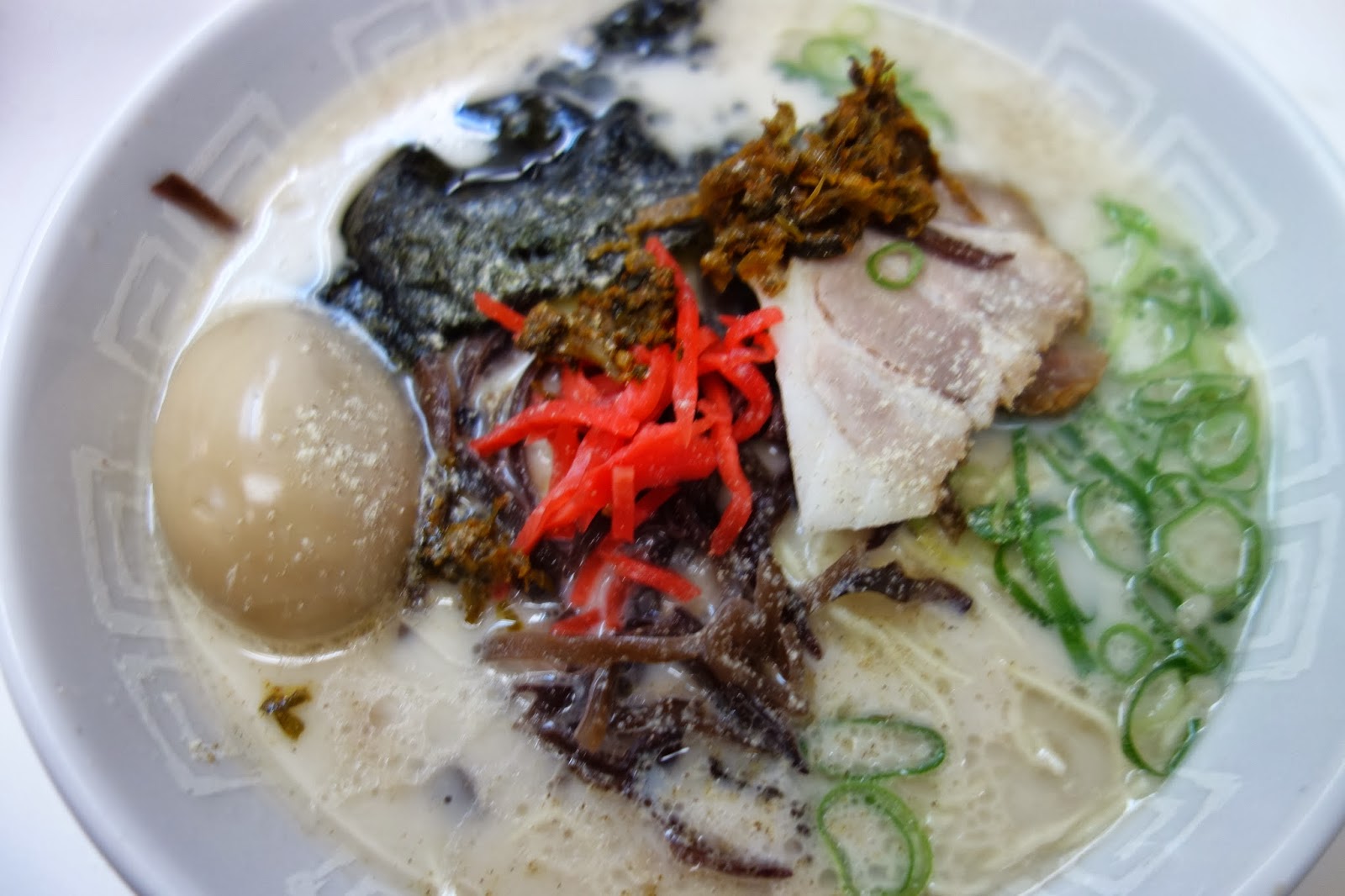
'TAMPOPO' RAMEN

After that huge feast Sensei called 'lunch' today I thought I do not need any food until tomorrow.  Equipped with a 1-hour cigar I commenced to walk from Ginza 2-chome, foot lose and fancy free in real terms. Then I hit Shimbashi Station and I realized there is no such thing as 'I am full' when one is in the spell of Ramen, absolutely my Archilles' Heel.

Have you watched a Japanese movie made in the 80's called Tampopo, starring Tsutomo Yamazaki?  It was about a rough and tough but soft-hearted sentimental truck driver, a regular at a Ramen noodle stop, who tried to save the owner's widow from having to close the tiny joint. It was beautifully directed but central to this plot was an 'Olde to Ramen'. I loved the scene when he lectured everyone on how to nurse a bowl of Ramen.  I watched it so many times I can memorize the lines, which goes something like this.

*  when it is served piping hot look at it, with admiration, enjoy the effusing smoke
*  bend your nose to the bowl, breathe in the unique fragrance
*  close your eyes, in anticipation of imminent gratification
*  push the 2 pieces of pork belly with chopsticks into the soup
*  this step will warm, or rather, wake them up
*  use the spoon and fill it with the creamy pork bone based stock
*  take a first sip, let it stay in your mouth, relish the intensity of the taste
*  add the julienne of pink ginger & brown preserved vegetables
*  toss the noodle a bit, tenderly & not to much, so the soup can come forward
*  then and only then do you take your first bite of the noodles
*  always slurp, take a deep breath and draw  
*  now you can dig up the pork and address them
*  before the end use both hands to lift the bowl and down every last drop of the soup
*  do not forget the ice water on the side, a necessary cleanser so drink it

I have no idea where exactly this shop is, suffice to say it is near the Shimbashi Station.  Comes hell or high water I will visit it again, perhaps tomorrow even.  Y500 plus Y50 for the tamago .. total Y550 ($42) for a quick visit to Heaven, this is what Value-for Money is about.

I am at an all time high right now.  I have said many prayers recently for things that have troubled me. Let me say this, whoever looks after me upstairs is answering ... not directly to solve my problems, but indirectly to steer me away from pain and return to joy, over an unbeatable bowl of Ramen, on the streets of Tokyo.

I thank you ... thank you so much for being kind to me!